








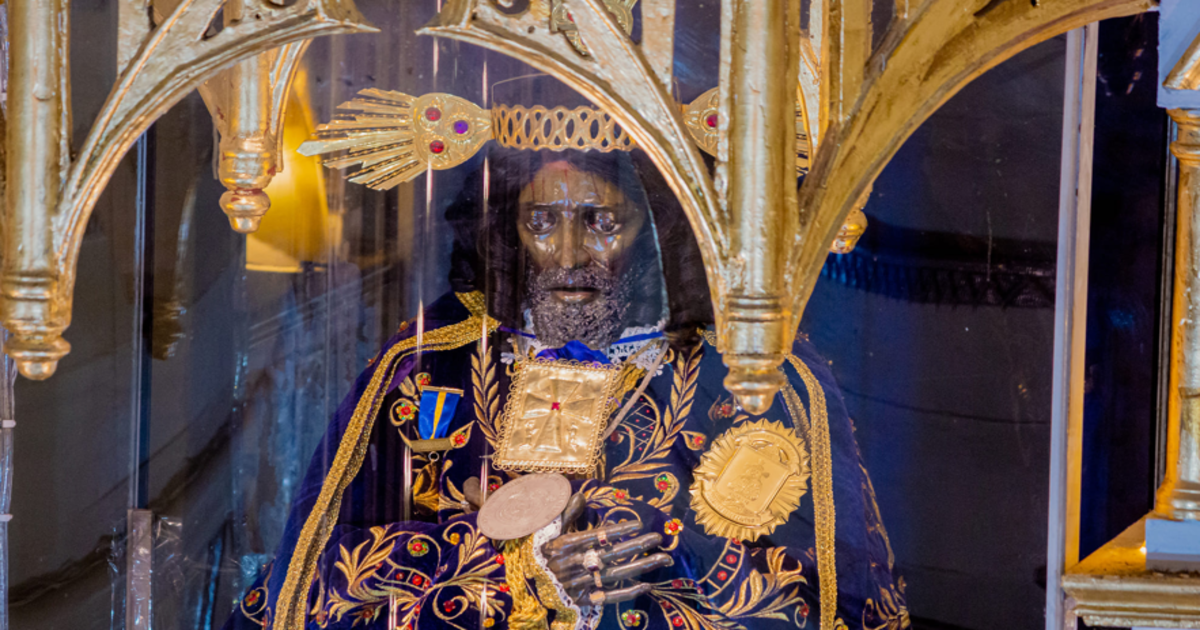
The Lord Captive of Ayabaca is the religious image that every October 13th summons thousands of devotees to the highlands of Piura, transforming the date into the central day of one of the most important cultural and religious manifestations in northern Peru.
Read also: Triple Cherry launches Harlequin Wilds 2
That day has gained such social relevance that regional authorities have made it an official non-working day in Piura to facilitate citizen participation in the celebrations and pilgrimage.
Origin and tradition of the Lord Captive of Ayabaca
The devotion to the Lord Captive has local roots that mix history, miracle, and legend. A version spread by tradition recounts that, in the 18th century, a priest wanted to gift an image of Christ to the town and that the wood used showed extraordinary signs that fueled collective faith; thus was born the veneration that today guides processions and popular vows.
Over the years, the festivity has incorporated elements of popular religiosity: collective prayers, fulfilled promises, regional dances, and offerings that reflect the cultural identity of Ayabaca and its territory.
Pilgrimage and community of the Lord Captive of Ayabaca
The strength of the Lord Captive is not limited to the district that houses him; every year thousands of pilgrims arrive from different provinces of Piura, from the nearby coast and highlands, and even from northern regions of Ecuador, on journeys that last for days and during which community solidarity is evident in makeshift water, food, and medical aid stations along the way.
The pilgrimage routes function as spaces for intergenerational encounters where family stories are renewed, songs of faith are transmitted, and cultural belonging is reaffirmed.
Heritage recognition
The historical and cultural value of the festivity was formally recognized by the State: the celebration of the Lord Captive was declared Cultural Heritage of the Nation, a recognition that protects its manifestations and promotes its dissemination as part of the Peruvian cultural heritage.
Read also: Stretch Network announces major updates to Spin & Go tournaments, launching December 2nd
That recognition has driven local and regional initiatives to protect the mass, dances, traditional clothing, and objects linked to the devotion, as well as to boost the arrival of visitors interested in popular religious culture.
Meaning today
For the population of Ayabaca and its numerous faithful, the Lord Captive is both solace and memory; prayers for health, work, and family peace are received, and it symbolizes the capacity of a community to sustain practices that dignify its history.
The festivity has transcended the strictly liturgical to become a local economic engine in October: accommodations, food sales, handicrafts, and services related to religious tourism increase in the area, generating income that many families need throughout the year.
How to experience the festival
If you plan to participate in the pilgrimage or visit Ayabaca on October 13th, it is advisable to inquire about safe routes, mass schedules, and local regulations. Respecting the community’s rhythm, following the instructions of organizers and authorities, and preserving the natural environment are attitudes that honor the tradition and protect those who celebrate it.
The festivity of the Lord Captive combines devotion and culture; approaching it with simplicity and respect allows for a better understanding of why, every October 13th, Ayabaca beats with a faith that is felt in every town and on every road.
Read also: BetConstruct AI Recognized as Best Platform Provider 2025 at SiGMA South Asia Awards